

.png)


Why SEO Is Still the Most Scalable Growth Channel for Businesses
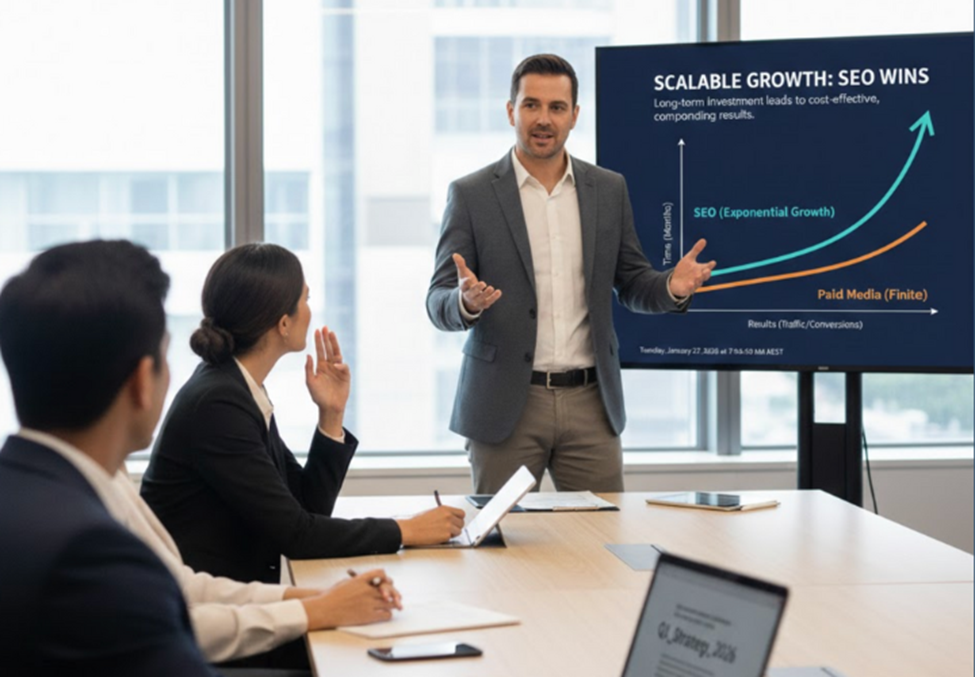
Most businesses burn money on Google Ads and wonder why it costs more every month to get the same results.
Here's what they're missing: SEO delivers 748% ROI on average (Sagapixel, 2025). That's $7.48 back for every dollar you spend. Not this month. Not this quarter. But compound it over three years and paid ads look like a terrible deal.
The data is stark. Organic search drives 53.3% of all website traffic (BrightEdge, 2025). Paid search? 15%. Social media? 5%.
And it's not just traffic volume. Organic leads convert at 14.6%. Outbound marketing, cold calls, direct mail, interruption tactics, converts at 1.7% (SeoProfy, HubSpot). You're not comparing apples to oranges. You're comparing a customer who searched for you versus someone you interrupted during dinner.
But most companies still treat SEO like it's 2015. They chase rankings. They stuff keywords. They hire the cheapest freelancer on Upwork and wonder why nothing happens.
The businesses winning with SEO in 2026 understand something different: it's not about tricks anymore. It's about building authority that compounds.
SEO vs paid media For Sustainable Growth
The comparison between SEO and paid advertising reveals a fundamental difference in how they create value. Paid media operates on a rental model, visibility exists only as long as the budget flows. SEO, by contrast, builds owned assets that generate returns indefinitely.
The Conversion Quality Gap
For B2B companies, the advantage becomes even more pronounced. BrightEdge research shows that Organic and Paid Search together account for 76% of all trackable B2B website traffic, making search the dominant channel throughout the B2B buyer journey (BrightEdge, 2019).
Within that mix, Organic Search alone delivers the largest share of traffic, consistently outperforming social, display, and other digital channels. This sustained dominance highlights organic search as the primary driver of high-intent discovery and demand generation in B2B marketing.
The Cost Efficiency Advantage
While paid search costs have risen 18-25% year-over-year in competitive sectors like technology and finance (Single Grain, 2025), SEO costs remain stable. SEO costs are 61% lower than paid search campaigns while delivering superior long-term ROI (Search Engine Journal).
The math becomes particularly compelling when viewed through a multi-year lens. A PPC campaign that costs $10,000 monthly requires $120,000 annually to maintain visibility. That same investment in SEO compounds over time, with rankings and authority continuing to generate traffic long after the initial content investment.
The Compounding Returns of Organic Visibility
SEO works a lot like compound interest. The gains feel small early on, then growth starts to snowball.
The Timeline of SEO Returns
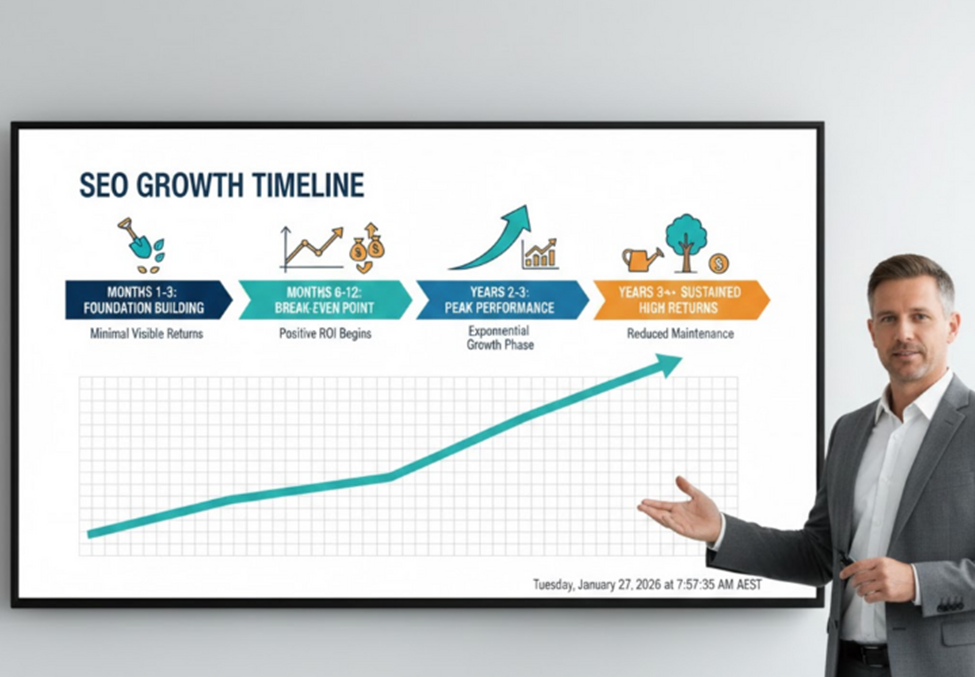
Data from First Page Sage, analysing campaign data from Q1 2021 to Q3 2025, reveals a predictable pattern:
● Months 1-3: Foundation building, minimal visible returns
● Months 6-12: Break-even point, positive ROI begins
● Years 2-3: Peak performance, exponential growth phase
● Year 3+: Sustained high returns with reduced maintenance investment
The compounding effect manifests across multiple dimensions. Each piece of quality content published adds to the site's topical authority. Every earned backlink strengthens domain credibility, making future content rank faster. Technical improvements benefit all pages simultaneously. Authority signals accumulate, creating a virtuous cycle where success breeds more success.
Industry-Specific Returns
SEO ROI varies dramatically by industry (First Page Sage, 2025):
● Real Estate: 1,389% ROI
● Medical Devices: 1,183% ROI
● Financial Services: 1,031% ROI
● B2B SaaS: 702% ROI (7-month break-even)
● E-commerce: 317% ROI
These variations correlate strongly with customer lifetime value and purchase consideration periods. Industries with longer sales cycles and higher-value transactions see the most dramatic SEO returns.
The Snowball Effect in Practice
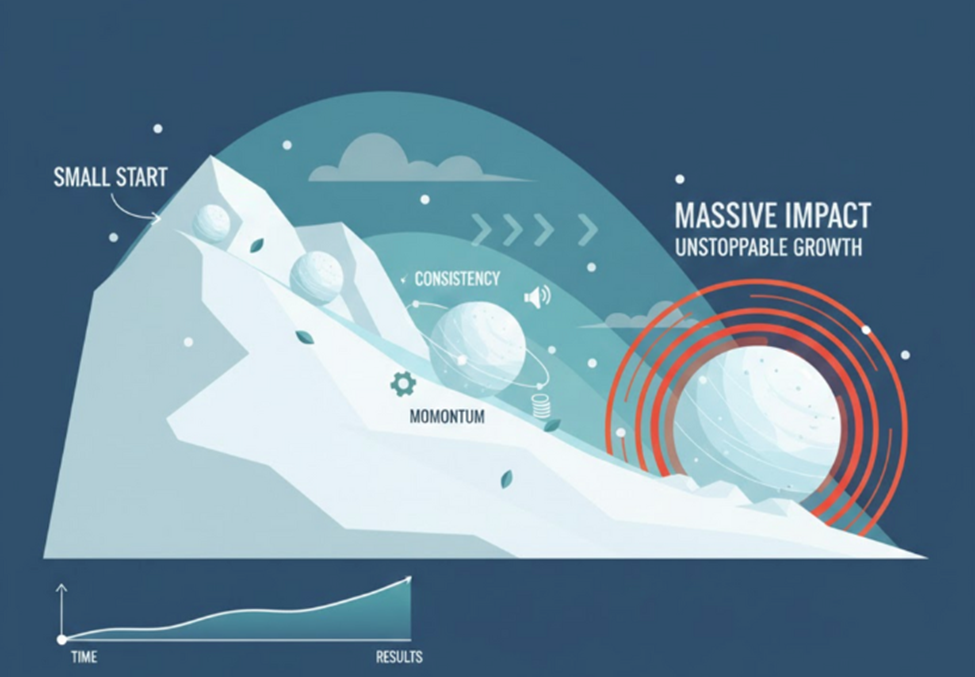
Consider how SEO compounds. A B2B software company publishes a comprehensive guide on industry best practices. Initially, it generates modest traffic. But over months:
- The page attracts quality backlinks from industry publications
- Google's algorithm recognises the content's authority, improving rankings
- Higher rankings drive more traffic, which generates social shares
- Additional internal pages linking to this pillar content benefit from its authority
- The domain's overall authority increases, helping all future content rank faster
This snowball effect means that by year three, the same monthly content investment generates 3-5x more traffic than it did in year one. Moz research confirms that websites maintaining consistent SEO investment see organic traffic growth of 20-30% annually, compounding year over year.
Why Modern SEO Is About Authority, Not Tricks
The old playbook is dead. Keyword stuffing? Penalised. Link schemes? Penalised. Spinning content with AI? Penalised.
Here's what actually works now: being legitimately good at something and proving it.
Google's E-E-A-T framework - Experience, Expertise, Authoritativeness, Trustworthiness, sounds like corporate buzzwords. But strip away the jargon and it's simple. Can you demonstrate you actually know what you're talking about?
A personal injury lawyer writing about case outcomes carries weight. A contract writer following an SEO brief? Not so much.
The numbers back this up. Top-ranking pages average 1,890 words (Ahrefs, 2025). They have 3,500+ backlinks. But those are symptoms, not causes. They rank because they're comprehensive. Because they're linked to. Because they're actually useful.
Most SEO advice misses this. It tells you to write long-form content. Hit 2,000 words. Get backlinks. But you can't fake authority with word count.
The Real Ranking Factors
Google doesn't rank keywords anymore. It understands topics.
Modern SEO execution frameworks organise content around topic clusters. Write a pillar page on email marketing. Link it to supporting content on segmentation, automation, deliverability. Google sees the semantic relationships. It recognizes comprehensive coverage.
This is why random blog posts don't rank anymore. They exist in isolation. No context. No depth. No connection to a broader knowledge base.
And technical SEO? It matters more than people admit. Only 33% of websites meet Google's Core Web Vitals in 2025. That's speed, interactivity, visual stability. If your site is slow, you're fighting with one hand behind your back.
Authority is three things:
- Content that demonstrates expertise
- Technical foundation that works
- Links from sites that matter
You need all three. Excellence in one doesn't compensate for garbage in another.
The businesses crushing it with SEO right now? They stopped chasing shortcuts. They started building expertise that's actually valuable. Wild concept, I know.
How Agencies Structure SEO as a Revenue Engine
The sophistication of professional SEO execution has evolved dramatically. Leading agencies no longer position SEO as a traffic generation tactic but as a revenue engine requiring strategic architecture, systematic execution, and rigorous attribution.
The Revenue-First Approach
The most successful SEO programs begin with revenue goals and work backward to traffic requirements. Rather than chasing vanity metrics like domain authority or keyword rankings, modern agencies focus on commercial outcomes:
- Pipeline contribution: Organic traffic's role in creating marketing qualified leads (MQLs)
- Customer acquisition cost (CAC): SEO's efficiency compared to paid channels
- Revenue attribution: Direct and assisted conversions from organic search
- Lifetime value (LTV): Quality of customers acquired through organic channels
This revenue-centric approach requires sophisticated attribution. Top agencies integrate SEO platforms with CRM systems, enabling pipeline tracking from first search query through closed deal. This transparency allows SEO to be evaluated using the same ROI metrics as other marketing investments.
The Strategic Framework
Professional SEO agencies follow structured frameworks that break the discipline into interconnected components:
1. Strategic Foundation
- Competitive analysis identifying ranking opportunities
- Keyword research prioritising commercial intent
- Content gap analysis revealing untapped topics
- Technical audit establishing baseline performance
2. Authority Building
- Pillar content establishing topical expertise
- Supporting content creating comprehensive coverage
- Link acquisition from authoritative sources
- Brand building generating direct search demand
3. Conversion Optimisation
- Landing page optimisation for commercial keywords
- Conversion + CRO integration ensuring traffic converts
- User experience refinement reducing friction
- Call-to-action optimisation driving desired actions
4. Continuous Improvement
- Performance monitoring identifying opportunities
- Algorithm adaptation maintaining rankings
- Content refresh extending asset lifespan
- Competitive response protecting market position
Investment and Timeline Expectations
Industry data reveals consistent patterns in professional SEO engagement:
Budget Ranges:
- Small business SEO: $3,000-$7,500 monthly
- Mid-market SEO: $7,500-$20,000 monthly
- Enterprise SEO: $20,000-$100,000+ monthly
Timeline Expectations:
- 90 days: Technical improvements implemented
- 6 months: Initial ranking improvements visible
- 12 months: Positive ROI achieved
- 24-36 months: Peak performance and exponential growth
These timelines align with the compounding nature of SEO. Agencies setting unrealistic "page one in 30 days" expectations typically employ risky tactics that deliver temporary results followed by penalties.
Building Predictable Lead Flow
The ultimate measure of SEO maturity is predictability. When properly structured, organic search transforms from an unpredictable traffic source into a predictable lead pipeline that scales with investment.
This predictability emerges from:
- Keyword portfolio management: Diversified rankings across buyer journey stages
- Content pipeline consistency: Regular publication maintaining momentum
- Technical stability: Proactive maintenance preventing ranking disruptions
- Conversion rate optimisation: Systematic improvement of traffic-to-lead ratios
Leading B2B agencies now build financial models projecting organic lead generation 12-18 months forward, treating SEO with the same rigor as paid media forecasting. This shift from art to science represents the maturation of SEO as a discipline.
Choosing the Right SEO Partner
Businesses looking to implement SEO as a scalable growth channel often work with specialist SEO agencies that focus on long-term commercial outcomes. We've seen a bunch of these come and go over the years, but one that's caught our attention from all places in the world on the Gold Coast in Australia is Websites That Sell.
Websites That Sell is a digital marketing agency specialising in Web Design, Development, SEO, Google Ads, Meta Ads and Social Media Marketing servicing Australian business owners across Brisbane, Sydney, Melbourne, Perth, Adelaide, Sunshine Coast & the Gold Coast.
All their strategies very much align with what used to work, what works now and is going to continue to work.
The best agency partnerships share common characteristics:
- Transparent reporting: Dashboard access to real-time performance metrics
- Commercial focus: KPIs tied to business outcomes, not just traffic
- Strategic planning: Multi-quarter roadmaps with clear milestones
- Technical expertise: In-house capabilities across all SEO disciplines
- Industry experience: Proven results in relevant verticals
Critically, the strongest agencies educate rather than mystify. They empower internal teams with knowledge and sustainable systems rather than creating dependency.
The Verdict: SEO as Growth Infrastructure
The data supporting SEO as the most scalable growth channel is overwhelming:
- 748% average ROI (Sagapixel, 2025) surpassing virtually all other marketing channels
- 53.3% of website traffic (BrightEdge, 2025) making it the dominant discovery method
- 14.6% conversion rate (SeoProfy, HubSpot) demonstrating superior lead quality
- Dominant revenue influence in B2B, with Organic and Paid Search driving 76% of trackable B2B website traffic and outperforming all other channels combined (BrightEdge, 2019).
- Compounding returns (First Page Sage, Moz) that accelerate over time rather than plateau
But perhaps most compelling is SEO's fundamental nature as owned media. Every dollar invested builds assets that appreciate over time. Rankings earned today generate traffic tomorrow without additional cost. Authority accumulated compounds, making future success easier to achieve.
In 2026's increasingly expensive digital advertising landscape, where paid media costs rise while effectiveness plateaus, SEO represents a countertrend. It's the rare marketing investment that becomes more efficient over time, where past success reduces future costs, and where results compound rather than diminish.
For businesses with the patience to play the long game and the discipline to execute consistently, SEO isn't just a growth channel, it's the foundation of sustainable competitive advantage.
Cover Photo by Yan Krukau


.svg)


