

.png)


The SEO Framework Agencies Use to Build Long-Term Authority (Not Short-Term Wins)
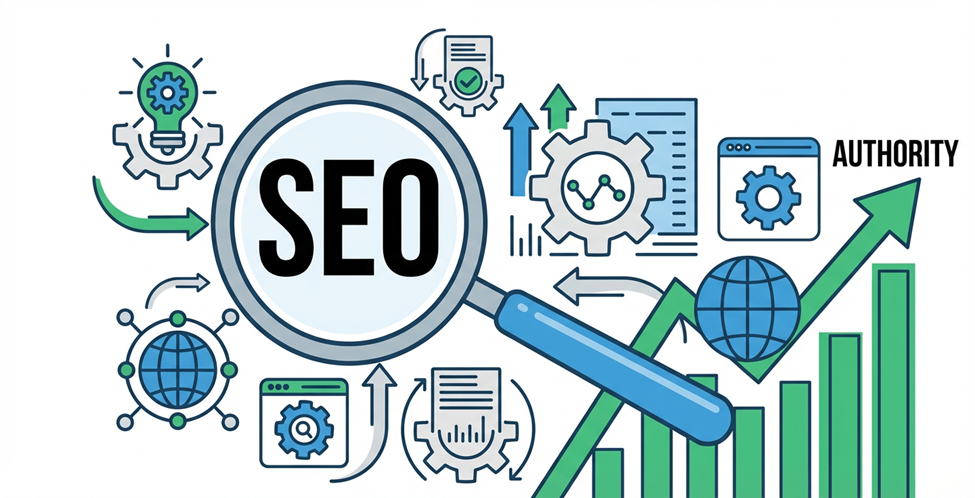
There's a weird disconnect happening in SEO right now, and it's costing businesses a fortune.
If you walk into any agency meeting, you'll hear the same thing. Business owner wants results in 90 days. Agencies promise page-one rankings. Everyone agrees to pump out content, check positions weekly, and measure success in traffic. Six months later, nothing's converting, and everyone's confused about what went wrong.
The problem isn't effort. It's expectations. In a 2025 analysis of millions of search results, Ahrefs found that the average page holding a top Google ranking is over three years old.
Not three months. Three years.
The pages sitting at number one didn't luck their way there. Someone built proper foundations first, sorted out the pages that actually make money, then filled in the gaps over time. It took time to move. But when it moved, it stuck.
Most businesses do the opposite. Content first, rankings second, and revenue... hopefully somewhere down the track. Then they can't work out why the phone's quiet.
The agencies getting real results work backwards from that. Foundations first, revenue pages second and supporting content last. It takes longer, but it actually works.
Why Most Businesses Build Their SEO Backwards
Your homepage carries the most weight. It's got the strongest backlink profile, the longest history, and the most internal links pointing to it. Everything else on your site should support that primary authority source, not compete with it. But that's not how most businesses approach it.
They'll publish 50 blog posts on industry trends while their core service pages sit there with generic titles and no optimisation. Or they're creating content on a site that takes seven seconds to load on mobile, then wondering why nothing ranks.
You can't blog your way out of technical problems.
Google research has found that about 53% of mobile users abandon a page if it takes longer than three seconds to load, and pages that meet Core Web Vitals thresholds see significantly lower abandonment rates. That’s not abstract algorithm talk, it demonstrates how better performance can be the difference between someone converting or bouncing back to the search results
The Foundation Problem
Google needs clear signals. What does your site do? Who does it serve? How do your pages relate to each other? Without that structure, you're asking an algorithm to guess.
This plays out constantly with e-commerce businesses. Product categories are created in whatever order makes sense for inventory management, not based on how customers think or search. The result is a site structure that confuses both users and search engines. Google needs clear topical signals to understand your authority. A disorganised site architecture makes that impossible.
Here's what needs to happen first:
- Site speed sorted
- URL structure that makes sense
- Mobile responsiveness that actually works
- Schema markup telling Google what your content is
- Internal linking that guides people (and crawlers) logically through your site
Get these right, and your content can actually do its job.
Focus on Pages That Actually Make Money
Most businesses optimise the wrong pages. They pour effort into blog posts that drive traffic but never convert, while their service pages, product categories, and location pages sit untouched. No optimised title tags, no commercial intent keywords, and more importantly, no strategy.
Title tags remain one of the strongest ranking signals Google uses, and optimising them for buyer intent delivers results quickly and consistently. Yet businesses waste this on blog posts like "10 Tips for Better Outdoor Lighting" while their festoon lights product page (the one that could actually generate sales) continues to be ignored.
A page ranking for "festoon lights" will generate more revenue than 10 blog posts about outdoor lighting tips ever will.

For local service businesses, that means:
- Homepage optimised for your main service + location
- Core service pages targeting what people actually buy
- Location pages for every area you serve
For e-commerce:
- Product category pages
- High-value product pages
- Commercial landing pages that match buyer intent
BrightEdge research has consistently shown that search engines play a major role in how people discover websites, with organic search accounting for roughly 53% of all trackable website traffic. But traffic alone doesn’t equal growth. The real impact comes from ranking for searches that align with genuine buying intent.
Understanding the strategic context of SEO as a scalable growth channel means knowing which pages actually drive business, not just which ones get traffic. Traffic to industry blog posts doesn't pay the bills.
When businesses treat SEO as a genuine growth channel rather than a traffic exercise, they typically partner with agencies that prioritise commercial results over dashboard metrics. On the Gold Coast, Websites That Sell who specialising in Web Design, Development, SEO, Google Ads, Meta Ads and Social Media Marketing servicing Australian business owners across Brisbane, Sydney, Melbourne, Perth, Adelaide, Sunshine Coast & the Gold Coast. Their ethos is to build strategies around technical infrastructure and revenue-generating pages before expanding into content. The focus is on foundational work like site speed optimisation, URL restructuring, and service page title tags. It's methodical, not flashy, but it's what actually delivers you ROI.
Then (Only Then) Comes the Content
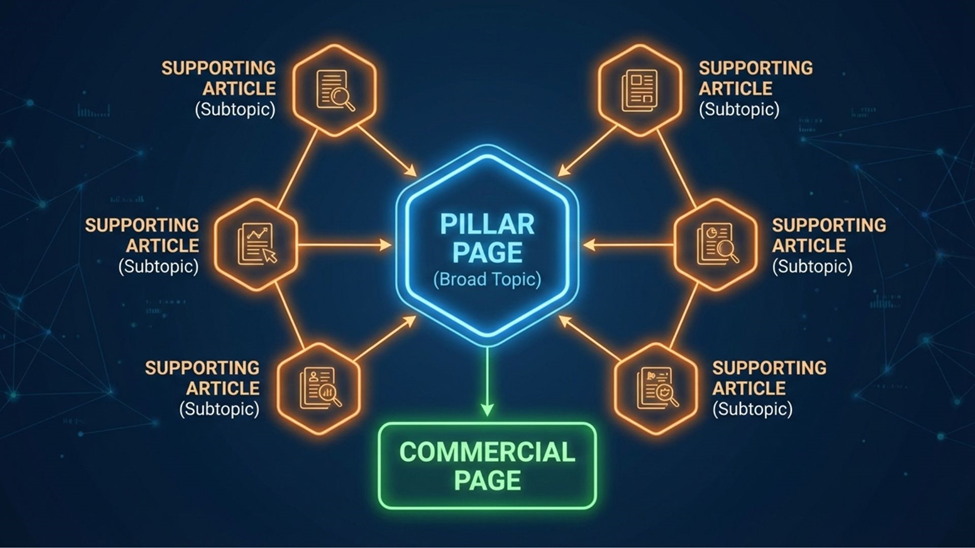
Once your foundations are solid and your money pages are optimised, content clustering builds topical authority.
Instead of random blog posts about whatever keywords you stumbled across, you create comprehensive content hubs around topics that support your commercial pages.
How it works:
- One pillar page covering a broad topic thoroughly
- Multiple supporting articles going deep on subtopics
- Everything links back to the pillar
- Strategic connections between cluster content and commercial pages
This supports revenue pages two ways:
First, you're targeting informational searches earlier in the customer journey. Someone searching "how to choose festoon lights" isn't ready to buy yet. But they will be. Your content gets your brand in front of them first.
Second, you're building semantic relevance. When Google sees comprehensive coverage of a topic, it trusts your commercial pages about that topic more.
The stats back this up:
Backlinko and BuzzSumo analysed 912 million blog posts and found that content over 3,000 words attracts 77.2% more referring domain links than posts under 1,000 words. But word count isn't the goal. Length only works when the topic demands it.
Organising this content into topic clusters (groups of related pages linked around a central theme) helps search engines recognise your expertise on specific subjects, which supports stronger organic visibility compared with publishing isolated posts. SEMrush research backs this up across thousands of sites.
But this only works after foundations are solid. Topic clusters on a slow, poorly structured site just mean more pages that don't rank.
Why Everything Needs to Work Together
If your social media team talks about one thing, your ads target another, and your SEO covers completely different topics, you're paying for three channels pulling in different directions.
Your ads should target highly commercial keywords to drive immediate sales, while your SEO targets people earlier in the buying journey with informational content. Someone searching "how to choose outdoor lighting" isn't ready to buy today. But three weeks from now, when they are, your brand is the one they remember because you helped them figure it out.
When your social media highlights specific topics and your blog explores them in depth, the channels reinforce each other. Social drives traffic, content earns backlinks, and engagement signals build across platforms.
Instead of competing for budget, everything compounds.
This matters especially for local businesses. Your brand message should be consistent whether someone finds you on Google, Facebook, or sees your van driving past.
Why This Takes Longer Than You Want (And Why That's Actually Good)
Most businesses want results in 30 days.
Good agencies will look for quick wins in that timeframe to prove the strategy works. Optimising title tags can shift rankings within weeks. Fixing critical technical issues can boost traffic fast.
But they're honest about the real timeline. Building authority takes at least 6-12 months.
The data on consistency:
HubSpot found that companies publishing 16+ blog posts monthly get 3.5x more traffic than those publishing 0-4 posts. That's not a "publish more and win" strategy. It's about consistent, strategic content over months and years.
Another Ahrefs' study of 2 million pages found that only 5.7% of newly published pages will rank in the top 10 within a year. The pages that break through faster? They're on sites with strong domain authority, proper technical foundations, and supporting content ecosystems. In other words, they've done the groundwork.
And here's where most businesses track success wrong:
They look at rankings alone. Rankings go up, they're happy. Rankings stay flat, they panic.
But rankings are just one signal, traffic is another, and conversions are another. But revenue is what actually matters.
You can rank page one but get no traffic if your title tag doesn't earn clicks. You can get traffic but no conversions if your pages aren't optimised for commercial intent. You can see traffic and conversions increase while rankings seemingly stay flat because you're capturing long-tail variations.
First Page Sage found that 39.8% of clicks go to the first position in Google search results. But that drops to 18.7% for position two and 10.2% for position three. Rankings absolutely matter. But not in isolation from everything else.
Properly measuring ROI from your SEO means tracking rankings, organic traffic, conversion rates, and revenue together. If you're not tracking everything properly, you don't actually know whether your SEO is working.
This is where DIY SEO falls apart. Some rankings improve, and they assume it's working. Meanwhile, traffic is flat, and conversions haven't budged.
Short-Term Tactics vs Long-Term Strategy
Short-term SEO involves shortcuts:
- Thin content targeting easy keywords
- Buying backlinks from dodgy networks
- Keyword stuffing that sounds robotic
- Publishing fast rather than publishing well
These might work briefly, but then Google updates their algorithm, and everything disappears. Ahrefs research shows that 96.55% of pages get no organic search traffic from Google, largely because they lack backlinks or topical authority.
Long-term authority building is slower, requires more investment upfront and doesn't deliver instant gratification.
But it compounds.
A properly structured site gets easier to add to over time. Topic clusters become more valuable as you add supporting content. Technical foundations improve performance across every page you publish.
The approach that works:
- Fix technical foundations before publishing content
- Prioritise revenue-generating pages over traffic-generating pages
- Build topic clusters that support commercial intent
- Align SEO with your other marketing channels
- Track full-funnel metrics, not just rankings
- Be honest about timelines and effort required
Most businesses want to skip straight to content because it's visible and feels productive.
Agencies that drive long-term results do the boring work first. Then expand strategically.
Takes longer, but it lasts longer.
The Reality of Building Authority That Lasts
Most businesses will keep chasing the 90-day promise. They'll bounce between agencies, reset strategies every quarter, and wonder why they're still on page three in year two.
The businesses that win are the ones willing to do it properly. Technical foundations first. Revenue pages optimised for commercial intent. Content that builds genuine topical authority. Everything is working together instead of competing for attention.
It's slower. It's less exciting to report on in month two. But in month twelve, when your competitors are still churning through agencies, you're the one ranking for terms that actually generate revenue.
If you're tired of agencies promising quick wins that disappear after three months, let's talk.
At Websites That Sell, we focus on technical foundations, revenue-focused optimisation, and sustainable authority building. No shortcuts, no dodgy tactics, just SEO that drives actual business outcomes.
Get in touch to discuss how we approach SEO for your industry and location.
Cover Photo by Antoni Shkraba Studio


.svg)


