

.png)


How Agencies Measure SEO Success Beyond Rankings and Traffic
SEO reports have looked the same for a long time.
Keyword positions. Traffic charts. A few screenshots from Search Console. Maybe a sentence about “continued growth”.
And yet, many business owners still ask the same question at the end of the month.
I’ve spent this much money on SEO… how much did it make me?
That gap is the problem with traditional SEO reporting.
Rankings and traffic show visibility. They do not show impact. They don’t explain whether SEO is helping generate enquiries, influence sales, or grow revenue.
Measuring SEO success purely by rankings and traffic is no longer enough.
Good agencies still track those metrics. And for good reason. Independent research from BrightEdge shows organic search consistently drives just over half of all website traffic across industries. But they still treat visibility as the input, not the outcome.
Coverage of the same research by Search Engine Land reinforces the point. Organic search dominates traffic, but traffic alone doesn’t explain business growth.
That only happens when SEO is run as a system, not a collection of disconnected tasks.
We interviewed a Digital Marketing Agency called Websites That Sell.
They are a digital marketing agency specialising in Web Design, Development, SEO, Google Ads, Meta Ads and Social Media Marketing servicing Australian business owners across Brisbane, Sydney, Melbourne, Perth, Adelaide, Sunshine Coast & the Gold Coast.
We love what they shared as they have proven to be a professional SEO agency and their approach to “reporting what matters” really caught our eye. So we’ve used that interview to put together the following guide on how to measure & report SEO success the right way to your clients.
We think it’s pretty awesome and hope it’ll help!
To start with let’s discuss…
Why Conventional SEO Metrics Fall Short
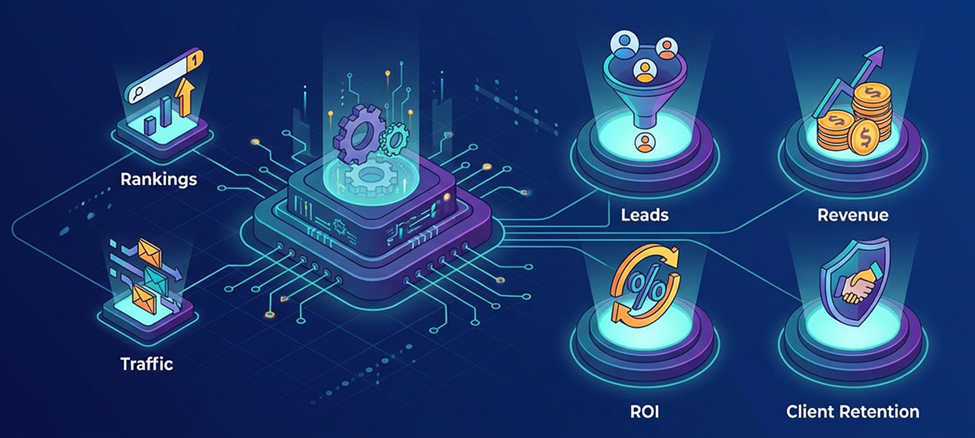
Rankings and traffic aren’t useless.
They’re just incomplete.
A page can rank number one and still be commercially irrelevant. A blog can pull in thousands of visitors and never generate a single enquiry.
We see both all the time.
The issue is intent.
Visibility without intent looks good in a report but doesn’t move a pipeline.
Some common problems with traditional SEO KPIs:
1) Rankings without conversion context
Ranking tells you where you appear in search results. It doesn’t tell you whether the people clicking are buyers.
Many sites rank well for informational keywords that attract researchers, students, or casual browsers. That traffic inflates reports but rarely turns into revenue.
Without linking rankings to conversions, you’re measuring position, not performance.
2) Traffic without commercial meaning
Traffic is only useful when you know what that traffic does next.
Ahrefs analysed billions of pages and found that over 96% receive no meaningful organic traffic. Most content fails not because SEO is dead, but because intent is wrong.
High traffic volumes don’t matter if the visitors aren’t a good fit for the business.
3) Bounce rate in isolation
Bounce rate is often misunderstood.
A high bounce rate can indicate poor relevance. Or it can mean the user found exactly what they needed and left. Without tying behaviour back to enquiries or assisted conversions, bounce rate doesn’t tell you much.
4) “Keyword growth” without revenue movement
This is the most common issue.
Reports show keyword improvements month after month, but sales stay flat. At that point, SEO hasn’t failed. Measurement has.
SEO that actually grows your revenue looks very different to SEO that simply boosts traffic or ranks keywords.
The Metrics That Matter: Business-Centric SEO KPIs
When agencies measure SEO properly, the focus shifts from visibility to outcomes.
1) Lead quality and quantity
The first metric that matters is simple. Organic enquiries.
That includes form submissions, phone calls, chat interactions, demo bookings, and quote requests. If organic traffic isn’t producing these actions, it’s not doing its job.
But volume alone isn’t enough.
A hundred low-quality enquiries can be worse than twenty strong ones. That’s why good agencies separate total leads from qualified leads.
Qualified leads are the ones that match the business. This is also where organic search tends to outperform many outbound channels. HubSpot’s inbound marketing research has shown that inbound leads, including SEO-driven leads, cost roughly 60% less than outbound leads on average.
This is where SEO stops being a marketing exercise and becomes a business metric.
2) Assisted revenue attribution
SEO rarely works in isolation.
In many cases, organic search introduces a business, answers early questions, or builds trust. The final conversion might happen through paid search, email, or direct traffic.
Google’s own attribution documentation makes this clear. Assisted conversions show when a channel appears earlier in the journey, even if it isn’t the final click.
If you only measure last-click revenue, you almost always undervalue SEO.
This is especially true for higher-value services and B2B sales. Industry research reported by Demand Gen shows buyers are often close to 70% through their decision-making process before they ever speak to a sales team.
SEO often does its work before the form is filled out.
3) ROI by campaign or asset
Strong SEO reporting doesn’t lump everything together.
Instead, it connects results to specific work. Service pages. Location pages. Content clusters. Conversion improvements.
For example:
- A service page rebuild leads to a steady lift in qualified enquiries.
- A pricing or comparison page starts influencing deals that later convert through other channels.
- A local page expansion opens up new demand in priority areas.
This approach allows SEO to be evaluated like any other investment. What was done. What it cost. What it returned.
4) Lifetime value and retention
For subscription businesses and recurring services, SEO measurement goes further.
Organic customers often arrive with higher intent because they actively searched for a solution. In many cases, they retain longer and spend more over time.
When lifetime value is factored in, SEO can outperform other channels even if the upfront cost per lead looks higher.
That level of insight requires clean tracking and a structured system. Without it, businesses are left guessing.
How a Good SEO System Enables Proper Measurement
Many businesses want better SEO reporting but don’t have the foundations in place.
A good SEO system includes a few non-negotiables.
1) Integrated analytics
SEO performance can’t be measured properly if data lives in silos.
At a minimum, this means:
- GA4 events configured correctly
- Search Console connected
- Call tracking where phone enquiries matter
- Some link between SEO data and CRM or lead tracking
Without this, you can see traffic but not outcomes.
2) Intent-led content planning
Keyword volume alone is a poor planning tool.
Platforms like SEMrush categorise keywords by intent: informational, commercial, and transactional. Commercial and transactional searches consistently signal higher purchase intent, even when search volume is lower.
A good SEO system plans content around intent first, not traffic potential.
3) Conversion built into the site
SEO doesn’t end when someone lands on a page.
If service pages are unclear, trust signals are weak, or calls to action are buried, traffic is wasted. Conversion optimisation and SEO are not separate disciplines. They rely on each other.
Research from McKinsey consistently shows that customer journeys are non-linear. Buyers move across multiple touchpoints, channels, and timeframes before converting. SEO pages need to support that journey, not operate in isolation.
4) Scalable reporting
Good reporting shouldn’t require manual explanation every month.
When the system is built properly, SEO outcomes can be tracked consistently and explained in plain language. Not all SEO systems are equal. Systems built around outcomes make real measurement possible.
Aligning SEO And Sales For Better Measurement Of ROI
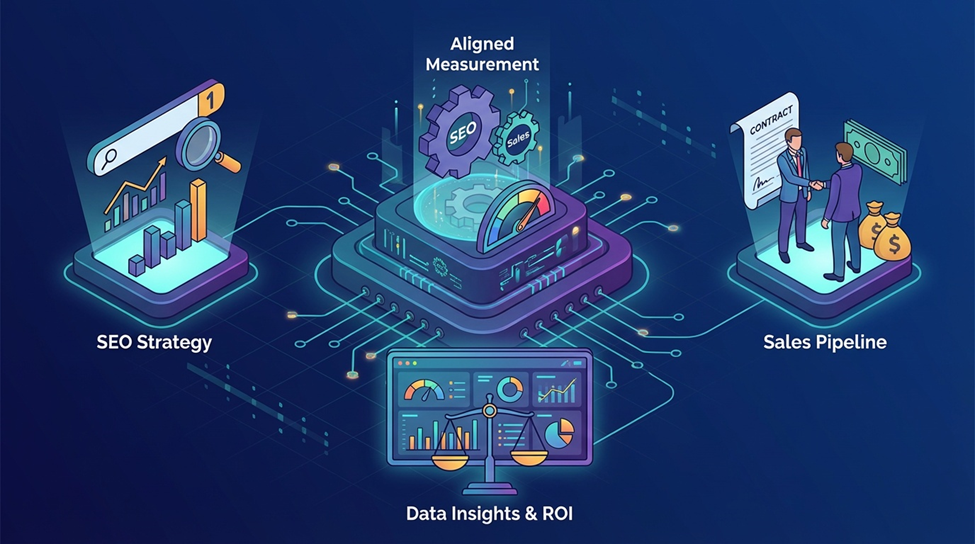
Even strong SEO data becomes meaningless if marketing and sales aren’t aligned.
This usually breaks down around one word. “Lead”.
If marketing reports enquiries and sales only values opportunities, everyone ends up frustrated.
Good agencies help align definitions early:
- What counts as a lead
- What makes a lead qualified
- Which stages matter in the pipeline
- What deal sizes and close rates look like
Shared definitions turn SEO reporting into something sales teams actually trust.
One caveat worth stating plainly. Not every business needs perfect attribution. Smaller service businesses often don’t need enterprise-level tracking to make good decisions. But relying on rankings alone is still a bad idea.
Directional data is fine. Blind spots are not.
Reporting That Makes Sense To Your Client
Business owners and busy executives don’t need more charts.
They need clarity.
Effective SEO reporting answers questions like:
- How many enquiries came from organic search?
- How many of those turned into real opportunities?
- How much revenue did SEO influence?
Instead of talking about keyword positions, good reports say things like:
- Organic search drove 23 percent of new opportunities this quarter.
- Qualified organic enquiries increased while total traffic stayed flat.
- SEO influenced deals that later closed through other channels.
Dashboards that matter focus on pipeline contribution, lead quality trends, assisted conversions, and revenue by page or campaign.
Here’s an example of a real life 90 day SEO report that in an instant gives the client understanding how much SEO drives their companies revenue & growth.
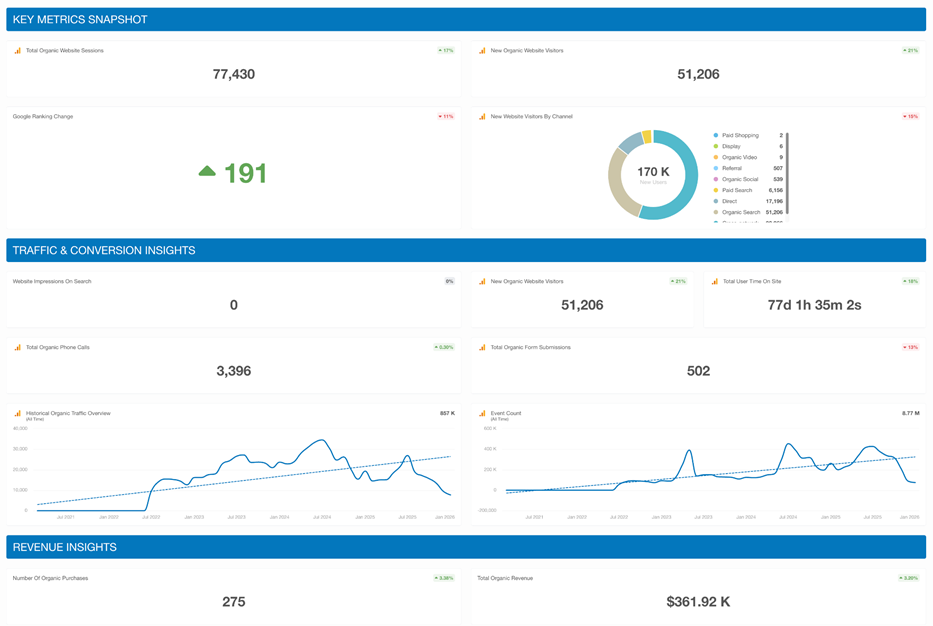
As you can see in a quick snapshot the most important drivers are discussed and compared against revenue.
How much revenue was generated - what traffic drove this revenue - how did SEO rankings contribute to this result.
Rankings still exist in the background.
But not the headline, they just help to paint the full picture!
Where to From Here?
SEO success is not about how many keywords you rank for or how much traffic you generate.
It’s about what that visibility produces.
Leads. Opportunities. Revenue. Long-term value.
Rankings and traffic still matter, but they are inputs.
Outcomes are the goal.
That’s why a good SEO system matters.
Without it, measurement stays shallow.
What you can’t measure you can’t improve - so just measure your SEO… the right way you’ve learned in this article.
Cover Photo by fauxels


.svg)


